
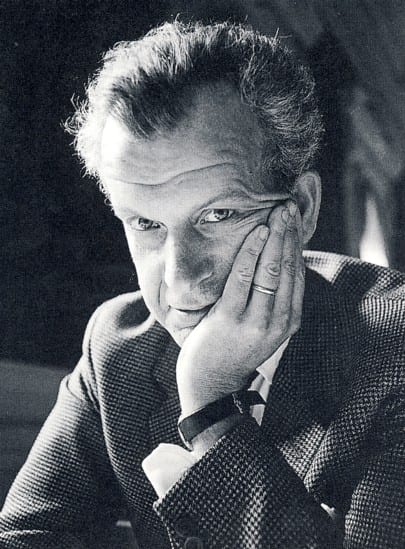
Peter Celsing (1920–1974) was one of Sweden’s most influential modernist architects.
He is best known for shaping the face of post-war Stockholm through massive public projects that balanced raw, “brutalist” materials with a deep sensitivity to light and human movement.
️ Architectural Philosophy
Celsing’s work is often described as robust and tactile. He had a unique ability to design buildings that served as a “backdrop to human activity” rather than dominating the landscape. His style evolved from the heavy, traditional brickwork of his early churches to the sleek glass and monumental concrete of his later urban projects.
️ Iconic Works
Celsing’s career was prolific, ranging from sacred spaces to the “machines” of modern governance and culture.
1. Kulturhuset (The Culture House), Stockholm
Completed in 1974, this is perhaps his most famous work. Located at Sergels Torg, it was designed to be an “oasis of culture” in the heart of the city’s commercial district.
-
Key Feature: The massive glass façade was intended to make the activities inside—reading, workshops, art—visible to the public on the street, blurring the line between private and public space.
2. Riksbankshuset (The Bank of Sweden)
Finished shortly after his death, the National Bank stands in stark contrast to Kulturhuset.
-
Key Feature: It is an impenetrable, fortress-like structure clad in black granite. It represents the weight and stability of the nation’s economy, yet the interior is surprisingly light and meticulously crafted.
3. Filmhuset (The Film House)
Designed to resemble a camera, this building features an exposed concrete façade with patterns that mimic filmstrips. It remains one of Stockholm’s most recognizable brutalist landmarks.
4. Sacred Architecture
Celsing was a master of church design, often using dark brick to create a sense of timelessness:
-
Härlanda Church (Gothenburg): Renowned for its simple, massive brick volumes.
-
Markuskyrkan (St. Mark’s Church): A collaborative influence with the legendary Sigurd Lewerentz, this building is considered a masterpiece of brick modernism.
Background & Career
-
Education: He studied at the Royal Institute of Technology (KTH) and the Royal Swedish Academy of Fine Arts in Stockholm.
-
Global Influence: Early in his career, he worked in Beirut, which broadened his architectural perspective beyond Scandinavian traditions.
-
Academic: He served as a professor of architecture at KTH from 1960 until his death.
-
Legacy: His son, Johan Celsing, is also a highly celebrated architect in Sweden today, continuing the family’s legacy of public and sacred design.
Recognition
Celsing was a multiple-time winner of the Kasper Salin Prize (Sweden’s most prestigious architecture award), most notably for Kulturhuset in 1972.